What are AI agents and how are they different from traditional gen AI?
AI agents are software systems that can reason, plan, and take actions to achieve goals with limited human involvement.
They differ from traditional generative AI in a few important ways:
1. **From single prompts to ongoing workflows**
- Traditional gen AI responds to one-off prompts (for example, “summarize this document”).
- AI agents use memory, reasoning, and planning to run multistep workflows, interact with tools and systems, and keep working toward a defined goal.
2. **From answers to outcomes**
- Instead of just answering questions, agents can execute tasks like performing code reviews, processing insurance claims, managing enterprise applications, or handling financial reporting workflows.
- They evaluate results, adjust their approach, and continue until the goal is met.
3. **Levels of autonomy**
Agentic AI spans a maturity scale:
- **Rule-based RPA**: Follows fixed rules with high human oversight.
- **Gen AI assistants**: Achieve specific, predefined goals (for example, a chatbot that answers FAQs).
- **Goal-driven agents**: Work toward higher-level objectives, not just single tasks.
- **Fully autonomous agentic systems**: Can independently set and achieve goals with minimal human oversight.
Industry analysts expect this shift to be significant:
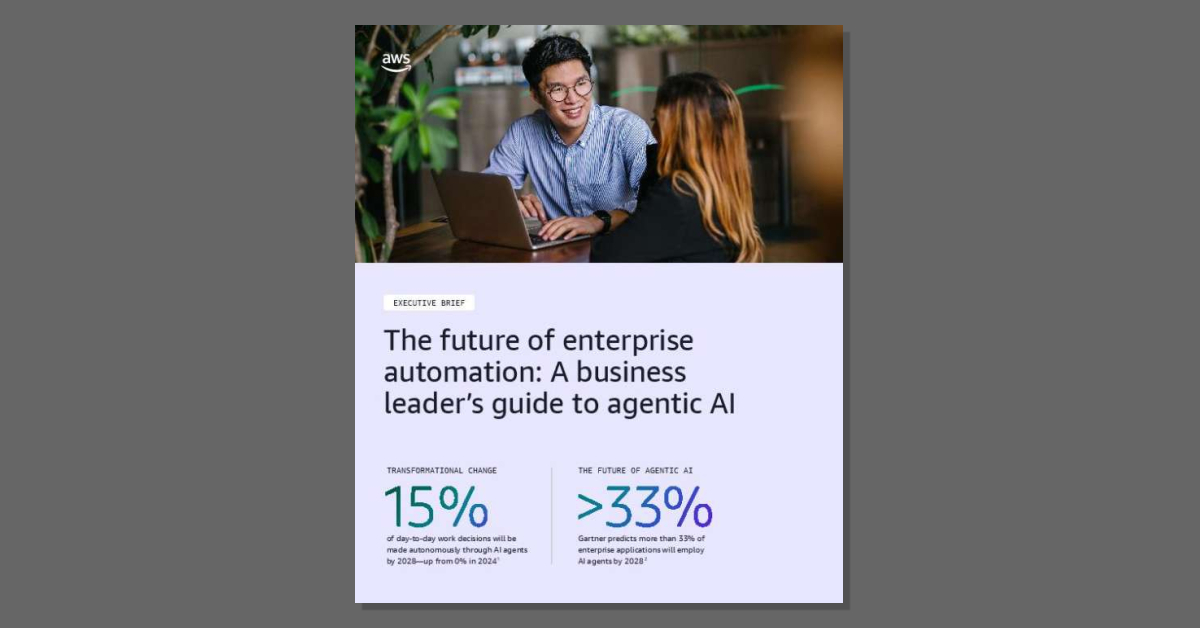
- By **2028**, more than **33% of enterprise applications** are predicted to employ AI agents.
- By the same year, a meaningful share of **day-to-day work decisions** is expected to be made autonomously by AI agents, up from essentially zero in 2024.
In short, AI agents move organizations from “ask-and-answer” AI to systems that can help reimagine how work actually gets done end to end.
How can agentic AI create business value today?
Organizations are already using agentic AI to reshape core operations and see measurable results. Four areas stand out:
1. **Boosting workplace productivity**
AI agents integrate with existing tools and workflows to automate routine tasks and decisions.
- The **NFL** used AWS business agents to cut **new-hire training time by 67%**.
- They also deployed a gen AI–powered assistant so fans can ask questions and get answers across a wide range of topics.
2. **Driving research and innovation**
Agents can analyze large datasets, identify patterns, test hypotheses, and generate insights at scale.
- Teams use this to shorten research cycles and move from weeks of analysis to same-day, expert-level insights.
3. **Optimizing business workflows**
Agents understand context, adapt to changes, and manage end-to-end processes.
- **Syngenta** saw about a **5% increase in crop yields** by using agentic AI to provide personalized seed recommendations and crop growth modeling for farmers.
- **Cognizant** automated mortgage compliance workflows with agentic AI and achieved **over 50% productivity improvement**.
4. **Accelerating software development**
AI agents support code generation, reviews, bug detection, and testing.
- **Thomson Reuters** used AWS Transform to modernize legacy code, cutting costs by **30%** and increasing transformation speed by **4x** compared to manual approaches.
Additional examples on AWS:
- **Formula 1** built a root cause analysis agent on Amazon Bedrock, reducing issue resolution time by **86%** and shrinking triage from days to minutes.
- **3M** uses Amazon Quick Suite so sales teams can query scattered data via natural language and automate routine tasks, helping move deals through the pipeline faster and compressing weeks of research into same-day insights.
- **Druva** built DruAI Agents on Amazon Bedrock AgentCore. Early results show **63% of issues resolved automatically** and escalations resolved **58% faster**. They are targeting **70% reduction in investigation time** and **90% automation** of routine data protection.
Across these use cases, the pattern is consistent: agentic AI helps organizations rethink how work is done, reduce manual effort, and improve speed and quality of decisions using measurable metrics, not just prototypes.
How should we get started with agentic AI and what does AWS provide?
Most organizations follow two main paths when they start with agentic AI, and AWS is set up to support both.
### 1. Choose your implementation path
**a. Specialized agents (fastest path to value)**
Deploy pre-built agents focused on specific functions such as customer service, IT operations, or business process optimization.
- Best when you want quick, targeted impact with minimal upfront build effort.
**b. Custom agents (tailored to your needs)**
Build your own agents using open-source frameworks and enterprise-grade foundation models.
- This path gives you flexibility to design agents around your unique workflows while relying on AWS for security, scalability, and reliability.
- You can build with **Amazon Bedrock** and **Strands Agents**, then deploy and operate them using **Amazon Bedrock AgentCore**.
Many organizations combine both: start with specialized agents for quick wins, then add custom agents for strategic, differentiated use cases.
### 2. Build the right foundation
To be ready for autonomous agents, three areas matter most:
**a. Data management**
AI agents need seamless access to diverse data types (structured, unstructured, and multimodal).
- AWS offers a broad set of services to manage the full data lifecycle so your data is discoverable, governed, and optimized for agentic AI workloads.
**b. Secure and responsible AI**
As agents gain more autonomy, they must operate within clear security, ethical, and regulatory boundaries.
- AWS is the first major cloud provider to receive **ISO 42001** certification for AI management, signaling a structured approach to responsible AI.
- AWS also provides automated reasoning checks that help reduce hallucinations and can reach up to **99% verification accuracy**, improving reliability and safety.
**c. Multi-agent environments**
As use cases grow more complex, single agents often hit limits. Multi-agent setups let specialized agents collaborate.
- **Amazon Bedrock AgentCore** helps you deploy and operate agents securely at scale, using any framework and model.
- It supports protocols like **Model Context Protocol (MCP)** and **Agent-to-Agent**, so agents can share context, coordinate tasks, and reduce integration friction.
According to recent data, **over 50% of companies already have AI agents in production**, and nearly **80%** have agents in development. AWS’s vision is to support a future where billions of agents work alongside people, with:
- **Pre-built tools and agents** for quick adoption.
- **Models and infrastructure** tuned for enterprise workloads.
- **Security, governance, and compliance** trusted by millions of customers.
In practice, your next steps could be:
1. **Deploy specialized agents** using solutions like **Amazon Quick Suite** or Kiro to improve productivity and automation.
2. **Build custom agents** with Amazon Bedrock and Strands Agents, then run them with Amazon Bedrock AgentCore.
This approach lets you move from experimentation to production and steadily reimagine how work gets done across your organization.




 Sign in with LinkedIn